Send E-Flower Tell a Friend Ask Gardener Resource Best Perennials Picture Perfect Perennials Culinary Plants Top Ten Design Tips How To Retailer Information Advanced Search
Company Logo
  Join our club! Join our discussion board!
November 07, 2009 
ToolBar
  Home
Home

Learn more here


  • The New Perennial Club
  • Newsletter/Archive
  • About Us
  • Contact
  • Media eMail Alerts
  • In the News
  • Top Sellers
  • Feedback
  • Bug Report
  • Poisonous Plants
  • Dealer Locator
  • Learn How to Search
  • Plant Tag Symbols


Click to learn more Click to learn more
Happy Ever Appster Daylilies Trophytaker Daylilies


Top Ten2001 Top 10

Welcome to our Heritage Perennials 2001 Top 10 List!

Our plants are chosen from over 1500 varieties we grow and from the many hundreds of new varieties introduced, discovered, or sometimes rediscovered every year! Some of these plants are time-proven classics which have a place in every garden. Some are exciting new varieties we think will become classics in the future. Others are simply interesting or cool plants we just got excited about and want to share with our many gardening friends.

Wherever you garden in North America, you should be successful with some or most of these varieties! You can still look for these Top 10 plants at your local independent Heritage Perennial dealer this spring, and happy gardening!

 
2001 Top 10 Heritage Perennials

#1
Zone 5  
  Carex oshimensis 'Evergold'
(Formerly known as C. morrowii 'Aureovariegata')
 
Picture
This Japanese sedge forms a low cascading clump of leathery green leaves, with a bright creamy-yellow stripe down the centre. Sedges are grass-like plants, mostly preferring sites with moist, rich soil. However, this variety also does well in dry shade - a bright accent for a difficult setting!

A choice plant for edging, or in the rock garden. Stays evergreen. If the tips of the leaves get wind-burned over the winter, they may be trimmed with scissors in the spring. This is a well-behaved, non-spreading plant. Clumps may be divided in early spring, every 3 to 4 years. Hardy to zone 5.


#2
Zone 4  
  Juncus effusus 'Unicorn'
 
Picture
What an exotic looking plant! This 'rush', or grass-like plant was recently introduced by the University of British Columbia Botanical Gardens, and is a vast improvement on the older varieties of Spiral Rush. Leaves are round and stem-like, with a unique corkscrew spiral all the way up to the tip. This selection is tall and sturdy, with a deep green colour and evergreen habit in mild-winter regions. Flowers are brownish and insignificant.

'Unicorn' is a superb choice for beside a pond or stream, as a marginal water garden plant, or in any damp sunny area. Great foliage for cut flower arranging. Stems may be trimmed back hard in spring. Hardy to zone 4.


#3
Zone 4  
  Geranium pratense Midnight Reiter strain
 
Picture
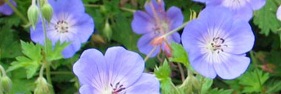
A new, 'Wow!' perennial! Compact, slow growing, this beauty has a place in every sunny garden! Valued for its stunning display of deeply cut plum-purple leaves that hold their colour through the whole season. Flowers are cup-shaped, violet-blue and held in loose sprays overtop of the foliage in late spring and early summer.

The compact size of this selection makes it perfect for mixed containers, rock gardens, or for edging in the border or woodland garden. Plants may benefit from a hard trim back after flowering is over, rejuvenating the leaves. Easily divided in early spring, every 3-4 years. Hardy to zone 4.


#4
Zone 3  
  Sedum telephium 'Matrona'
 
Picture
If you are looking a perennial that is: a) Outstandingly hardy b) Long blooming from summer into fall, c) Virtually problem free and d) Great looking even when it's not blooming, then you have to try this new Sedum!

'Matrona' is a recent German selection that has deep grey-green foliage with an edging of pink. Plants grow taller than most other varieties of Sedum, bearing large clusters of soft pink flowers. Even the dried seed heads have good winter effect. Truly one of the most exciting new introductions! Superb with ornamental grasses. A good cut-flower, also attractive to butterflies. Hardy to zone 3.


#5
Zone 5  
  Corydalis elata
 
Picture
For every gardener who loves blue flowered perennials (and who doesn't!) here is an outstanding new selection of blue Corydalis. Clumps of elegant, lacy yellow-green leaves bear upright stems of dangling bright, true blue tubular flowers, and this species blooms into summer even in hot climates!

Choose a rich woodland soil that remains evenly moist. Dislikes summer drought. Divide carefully in early spring. Spreads slowly to form a patch. Evergreen. Flowers are fragrant. Hardy to zone 5.


#6
Zone 2  
  Hosta 'Francee'
 
Picture
A true classic! Every year, the Heritage Top 10 collection includes one or two classic varieties that are outstanding staples for the garden. Hosta remain the most popular of perennials for shady areas, with hundreds of varieties now readily available. 'Francee', however, remains a superb choice for every garden.

What makes this plant so attractive is an exceptionally crisp white margin on deep-green leaves. As a bonus, pale-lavender flowers appear in July. Also try planting 'Francee' in mixed containers or tubs. Hardy to zone 2.


#7
Zone 4  
  Leucanthemum X superbum 'Snowcap'
 
Picture
Shasta daisies - no sunny border would seem complete without the familiar presence of these wonderful plants! One of the drawbacks to Shasta daisies, however, has been the tendency to flop over once in full bloom.

Now, try this especially compact winning selection that smothers itself with masses of single white flowers, each with a yellow centre. Admire how the plant remains remarkably sturdy during and after flowering! Excellent for cutting, great for edging or in mixed containers. Removing faded flowers will greatly increase the blooming time. Divide plants in the spring every 2-3 years to maintain vigour. Hardy to zone 4.


#8
Zone 5  
  Stokesia laevis 'Purple Parasols'
 
Picture
Introducing a new form of a North American native wildflower, and a wonderful addition to the sunny border. Flowers are a little like a huge, double Shasta Daisy in effect, but their colour starts light blue deepening to deep violet purple.

'Purple Parasols' are great as cut flowers and are also attractive to butterflies. A good candidate for mixed containers, although plants have a high water requirement! In the garden, plants are drought tolerant once established. Tolerant of hot, humid summer regions. Remove faded flowers to encourage more buds.
(US Plant Patent #10660. Propagation by license only.)


#9
Zone 3  
  Dianthus 'Cherry Moon'
 
Picture
Dianthus or 'Pinks' are like miniature versions of carnations and have been popular in gardens for centuries. Now, here is a selection recently introduced from England that features a grassy mound of evergreen leaves in a smoky grey-plum shade.

Come late spring, enjoy contrasting flowers of bright pink with a darker cherry eye and a clove-like fragrance. An excellent addition to the sunny rock garden, alpine trough or border! Plants should be trimmed lightly after blooming to maintain a tight, compact mound, and this plant does not like wet feet! Hardy to zone 3.


#10
Zone 4  
  Nepeta grandiflora 'Dawn to Dusk'
 
Picture
This brand new selection of Catmint from Europe is a little-known plant in North American gardens but promises to be a useful perennial for the middle of the sunny border. Unlike its blue flowered cousins, this plant offers spikes of soft pink flowers. These appear in early summer and will continue for an extended season if faded blooms are removed regularly.

Plants have a bushy, upright habit with sturdy stems of fragrant olive-green foliage. Come midsummer, plants can also be trimmed back to 6" to rejuvenate. Consider combining this with blue Delphiniums or the silver-leaved Artemisia 'Valerie Finnis'. Great for cutting! Hardy to zone 4.


 Credits Copyright © 2000-2009 Valleybrook International Ventures Inc. 

  Web services provided by Extreme Hosting